

Next
Summary
Thus Spoke Zarathustra Study Guide |
Next
Summary
|
Welcome to the LitCharts study guide on Friedrich Nietzsche's Thus Spoke Zarathustra. Created by the original team behind SparkNotes, LitCharts are the world's best literature guides.
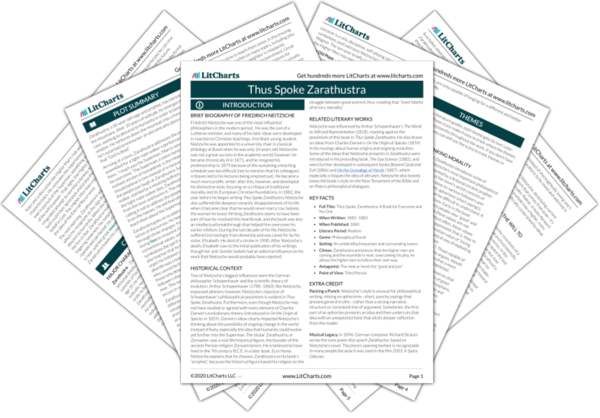
Packing a Punch. Nietzsche’s style is unusual for philosophical writing, relying on aphorisms—short, punchy sayings that present general truths—rather than a strong narrative structure or consistent line of argument. Sometimes, the first part of an aphorism presents an idea and then undercuts that idea with an unexpected twist that elicits deeper reflection from the reader.
Musical Legacy. In 1896, German composer Richard Strauss wrote the tone poem Also sprach Zarathustra, based on Nietzsche’s novel. The piece’s opening fanfare is recognizable to many people because it was used in the film 2001: A Space Odyssey.

 Quote explanations,
with page numbers, for over 50,238 quotes.
Quote explanations,
with page numbers, for over 50,238 quotes.
 PDF downloads
of all 2,253 LitCharts guides.
PDF downloads
of all 2,253 LitCharts guides.


